




Sustainability has become a default claim. Everyone uses the word. Few define it.
In the awards industry, it usually gets reduced to materials: recycled content, certifications, eco-friendly packaging. These things matter, and at Society Awards they're non-negotiable. Every piece we make uses recycled and recyclable materials, our facility runs on solar power, and our manufacturing is handled domestically with processes designed to minimize waste. But responsible production, on its own, is an incomplete answer. Because it ignores the most obvious issue.
Most awards are not kept.
The Real Problem
An award doesn't become sustainable because it uses a different substrate. It becomes sustainable if it's worth keeping. That's the part the industry tends to avoid, because it's easier to change materials than it is to raise standards. It's easier to describe sourcing than to confront whether the object itself has any lasting value.
But the outcome is visible. Awards that are generic, poorly designed, or cheaply executed don't get displayed. They don't move from one office to the next. They sit in a closet, then disappear. At that point, the environmental conversation is already over, and the most responsibly sourced award in the world has become landfill with a due date.
Longevity Is the Only Standard That Matters
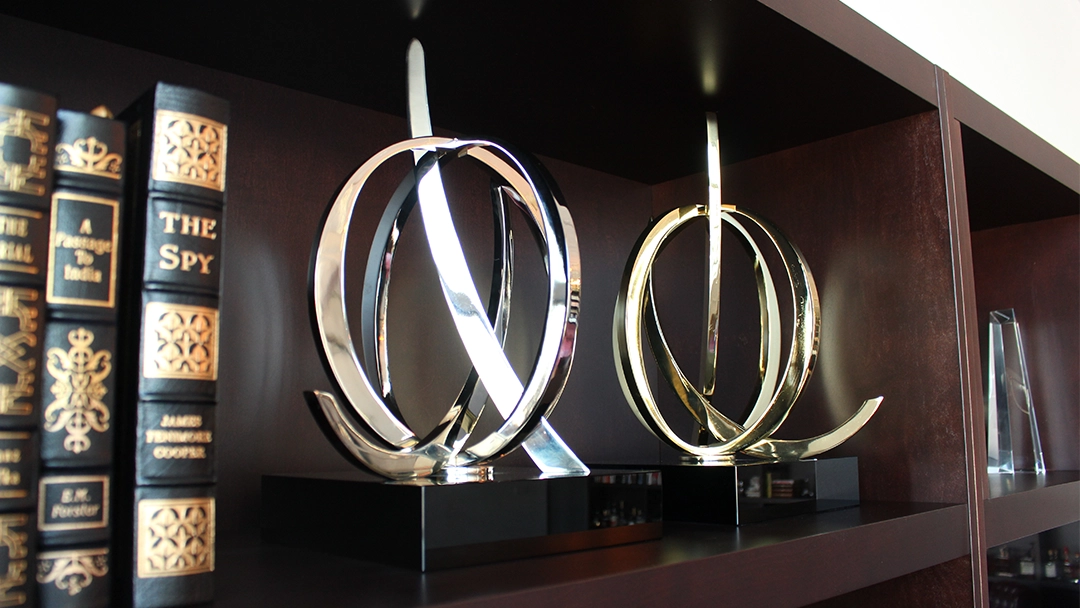
A well-made award does something very simple: it remains. It gets kept, displayed, carried forward through changes in role, company, and location. It becomes part of someone's personal and professional history, the kind of object that moves houses and eventually gets passed down.
That's what sustainability actually looks like in this category. Not a claim. A result.
When an object holds its place over time, the question of disposal never arises. A single long-lived piece quietly eliminates entire cycles of waste, replacing the recurring stream of low-quality awards that organizations reorder year after year, each one adding to the same pile.
Design Determines Outcome
Whether an award endures has very little to do with intention and everything to do with design. Objects that rely on novelty or surface treatment lose relevance quickly. Those that are overworked or overly literal rarely integrate into a space. They date themselves.
Objects that are resolved, restrained, and materially honest tend to stay appropriate over time. They don't compete for attention, but they don't disappear either. They hold their position.
This isn't accidental. It's the result of decisions made early: proportion, material, finish, and how the object relates to its environment. Those decisions are what determine whether an award will be kept or discarded. Luxury buyers already understand this logic. A well-made watch or a considered piece of furniture is more sustainable than a dozen disposable versions, because it lives longer, is cared for, and holds emotional value. Awards operate on the same principle.
A Different Standard
If the objective is to reduce waste, the answer isn't to produce "better disposable awards." It's to produce fewer, better ones. Objects that feel appropriate not only at the moment they're received, but in the years that follow.
There's a simple test for this. Ignore the buzzwords and ask one honest question:Will anyone still want this in 20 years? If the answer is no, it isn't sustainable, regardless of what the materials spec sheet says.
Where Society Awards Fits
This is the standard that guides everything we make. The objective isn't to produce awards that satisfy a moment. It's to create objects that remain relevant beyond it, through considered design, material integrity, and a level of craft that gives the piece genuine staying power.
The responsible foundation is already there: recycled and recyclable materials, domestic manufacturing, solar-powered production, and packaging and logistics that don't add unnecessary waste. But none of that gets presented as the primary achievement, because it isn't. It's the baseline.
The primary achievement is that the object is kept.
 PREVIOUS POST
