



What Does a “Bronze Finish” Actually Mean?
Gold, silver and bronze are so deeply associated with awards that we tend to think of them as three obvious colors. Bronze, however, is not nearly that simple.
The familiar hierarchy was cemented by the Olympic Games, but its origins are much older. Gold, silver, and bronze were valuable materials in their own rights, yet bronze in particular was enormously important in the ancient world because it was difficult to make, extraordinarily useful once created, durable, and capable of being melted and formed again. That history is part of the larger story we discuss in our article on the Ancient Origins of Awards.
Today, “gold,” “silver,” and “bronze” often describe the visual hierarchy of an award rather than its literal material composition. Even Olympic medals illustrate this evolution. Modern gold medals are not solid gold, and third-place medals have been produced in bronze alloys, copper, and other compositions while still being called bronze medals. What has endured is the visual language, and that creates an interesting question for modern award manufacturing: What exactly does someone mean when they ask for a bronze finish?
There is No Single Bronze Color
Bronze is not one material with one fixed appearance. Traditional bronze is principally an alloy of copper and tin, but there are many bronze alloys, and many other copper alloys are casually referred to as bronze even when they may technically be brass or something else. Their colors vary and more importantly, freshly polished bronze does not necessarily look brown.
Highly polished bronze can appear remarkably close to gold, sometimes slightly darker or warmer depending upon the alloy. Some copper-rich alloys may lean more toward copper but displayed on their own many polished bronze materials simply read as gold.
When oxidation begins, bronze changes color as the copper within the alloy reacts with its environment and develops a patina. Unlike rust on ordinary steel, this oxidation can form a protective surface over the material rather than simply destroying it.
Depending upon the alloy, environment, and amount of aging, bronze can move through many appearances, from a slightly muted golden tone to brown, dark brown, nearly black, green, or blue-green. So, if someone asks for something to “look like bronze,” the next question is inevitably: Bronze at what stage?
Bronze as a Third-Place Finish
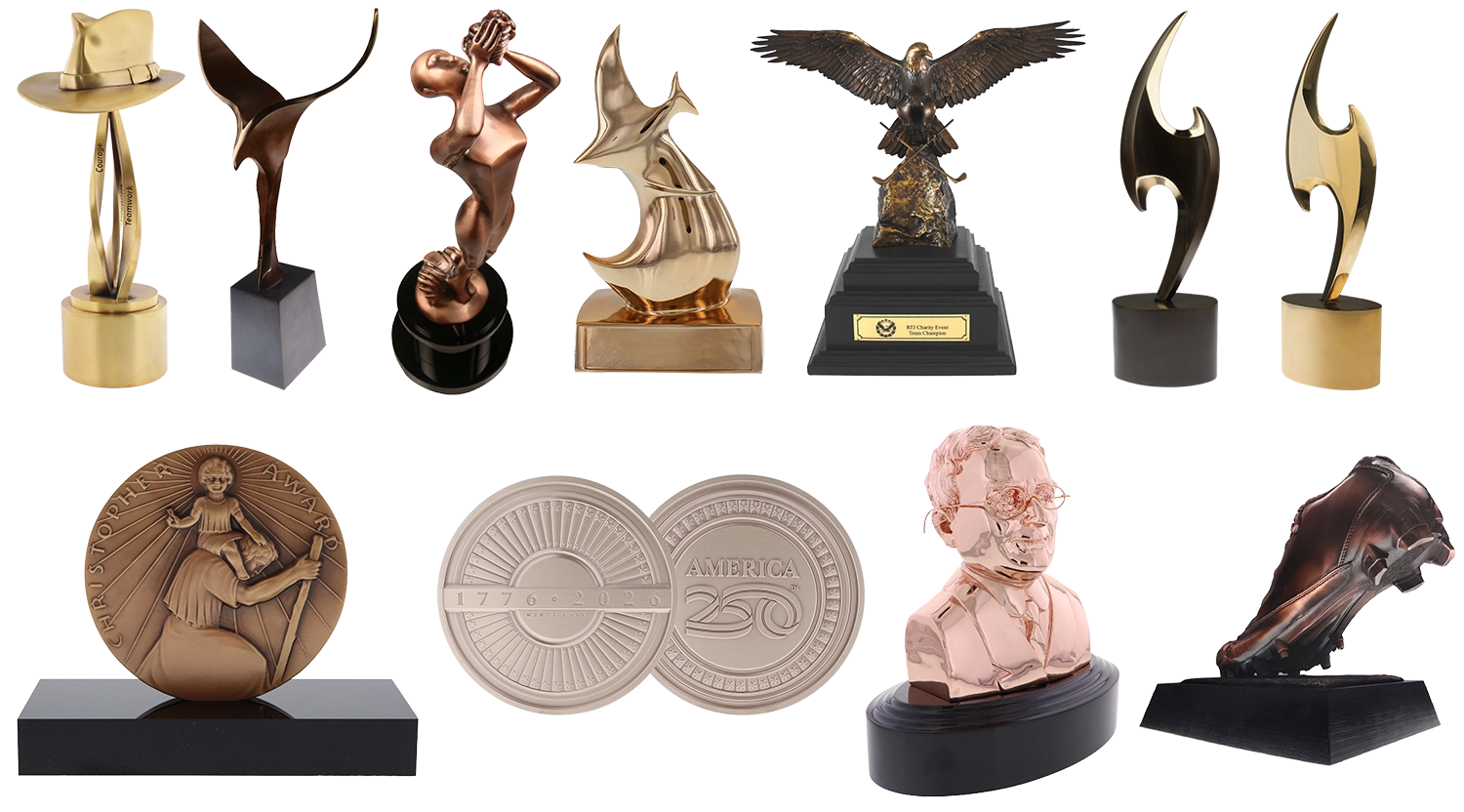
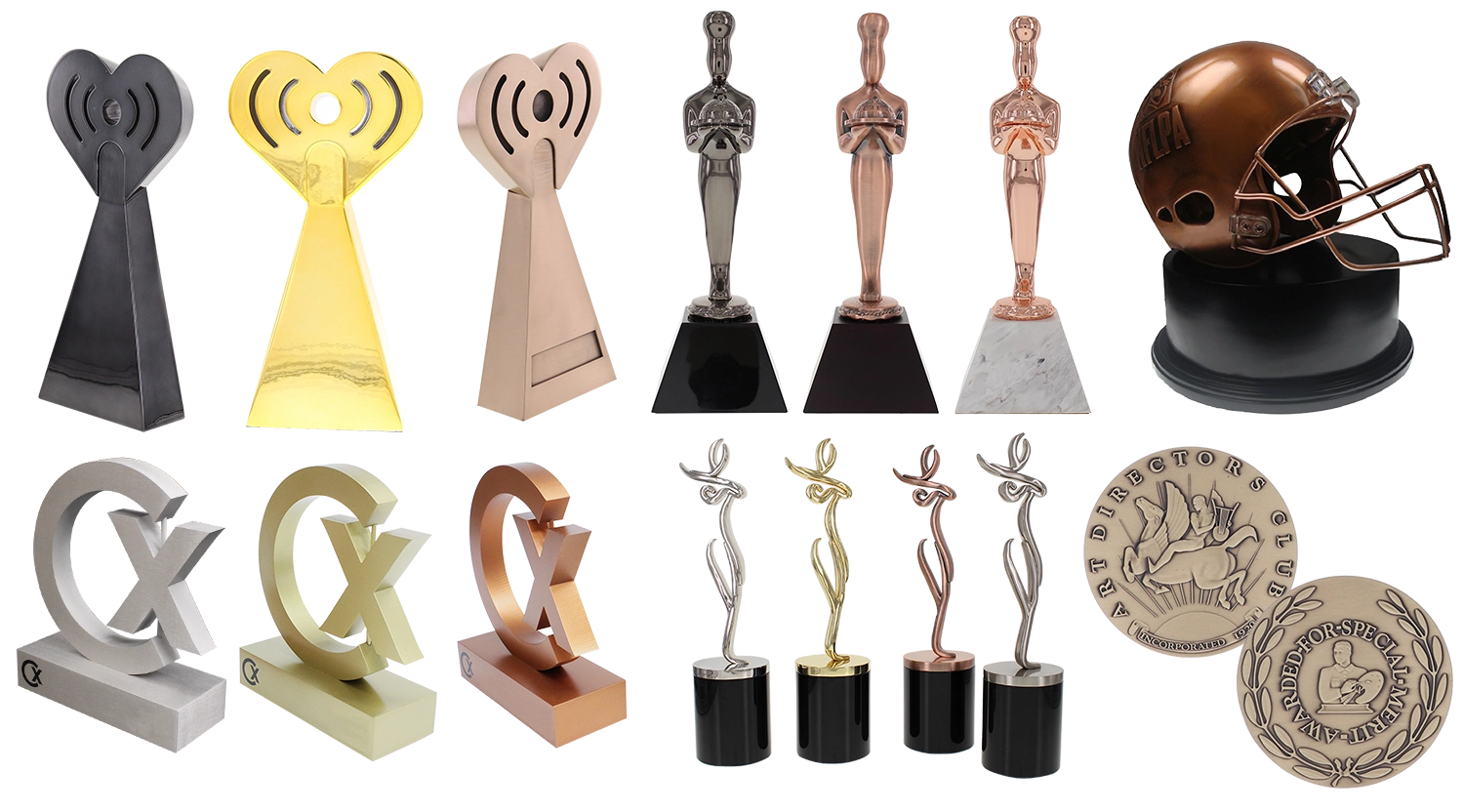
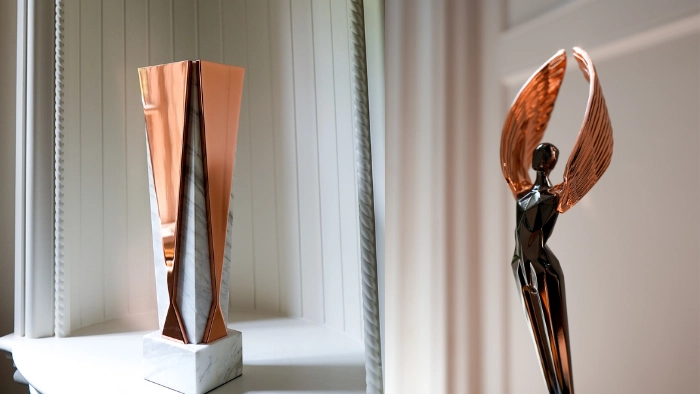
Most of the time, when gold, silver, and bronze awards are being produced together, the client is not really asking us to reproduce the natural appearance of a particular bronze alloy. They need a third finish that is immediately distinguishable from gold and silver. For that purpose, our default recommendation is generally a bright polished copper tone, similar to a new penny.
This tone is warm, metallic, and unmistakably different from gold and silver and has also become a widely understood visual shorthand for bronze in modern awards.
Additionally, there is a practical reason to use a bright, polished copper tone. If we reproduced freshly polished natural bronze too faithfully, the “bronze” award might look almost identical to the gold award beside it and the purpose of the hierarchy would be lost.
What If You Actually Want Bronze?
What if there is no award hierarchy and the client simply likes the aesthetic of bronze. In that case, we need to define the desired appearance much more precisely, such as:
- Do you mean freshly polished bronze?
- A darker matte gold?
- Slightly aged bronze?
- Deep brown antique bronze?
- A heavily weathered patina?
- Verdigris?
These are all legitimate interpretations, but they are not the same award finish.
There is also a curious modern interpretation of “bronze” that appears frequently in decorative products: an essentially mirror-shiny brown metallic surface. It can certainly be attractive, but it does not closely resemble naturally aged bronze. Bronze generally becomes brown because its surface has oxidized, and that same surface change also affects its reflectivity. A perfectly mirror-bright brown finish is therefore more of a designed representation of bronze than the appearance of natural bronze itself.
Again, there is nothing wrong with that. It simply means that “bronze” has become a color description rather than a precise material specification.
How Society Awards Creates Bronze Finishes
Society Awards offers multiple types of bronze finishes for clients, including electroplating, painting, and anodized aluminum.
For metal awards, Society Awards generally prefers electroplating when possible. We have established plating finishes including gold, silver, copper, and other standard metallic tones. These preserve the character of the underlying metal and can produce exceptionally rich surfaces.
A darker gold or unusual bronze tone can also be developed, but this should be understood as a specific finish target rather than a universally defined color. Electroplating is a chemical process, so subtle differences can also occur from one production batch to another.
For the painting option, a well-executed metallic bronze paint can look surprisingly convincing, particularly over a properly prepared metal surface. However, when an award is already made from metal, we generally believe it is a shame to cover that material with paint unless the desired appearance requires it.
Anodizing aluminum can create durable matte metallic finishes in a wide range of tones without creating the appearance of ordinary paint. The process produces a different character from mirror-polished plating and can be very effective when a softer metallic bronze appearance is desired.
And of course, an award can simply be made from genuine bronze or brass. Those materials can be polished and sealed with lacquer to slow oxidation and preserve their brightness. The amusing result is that a beautifully polished and protected bronze award may once again look surprisingly like gold.
What to Ask For With Bronze Awards
The most useful thing you can tell us is not simply that you want bronze. Tell us what you want bronze to look like.
If bronze means third place, we will generally recommend a bright copper tone so that gold, silver and bronze are immediately distinguishable. If the gold and silver awards are shiny, people don’t always want pre-aged third place trophy.
If bronze means an aesthetic, we will help determine whether that means polished bronze, antique bronze, brown patina, darker matte gold, copper or another warm metallic finish.
There is no single correct bronze color, and if we’re making a custom-bronze finish, it will vary batch to batch.